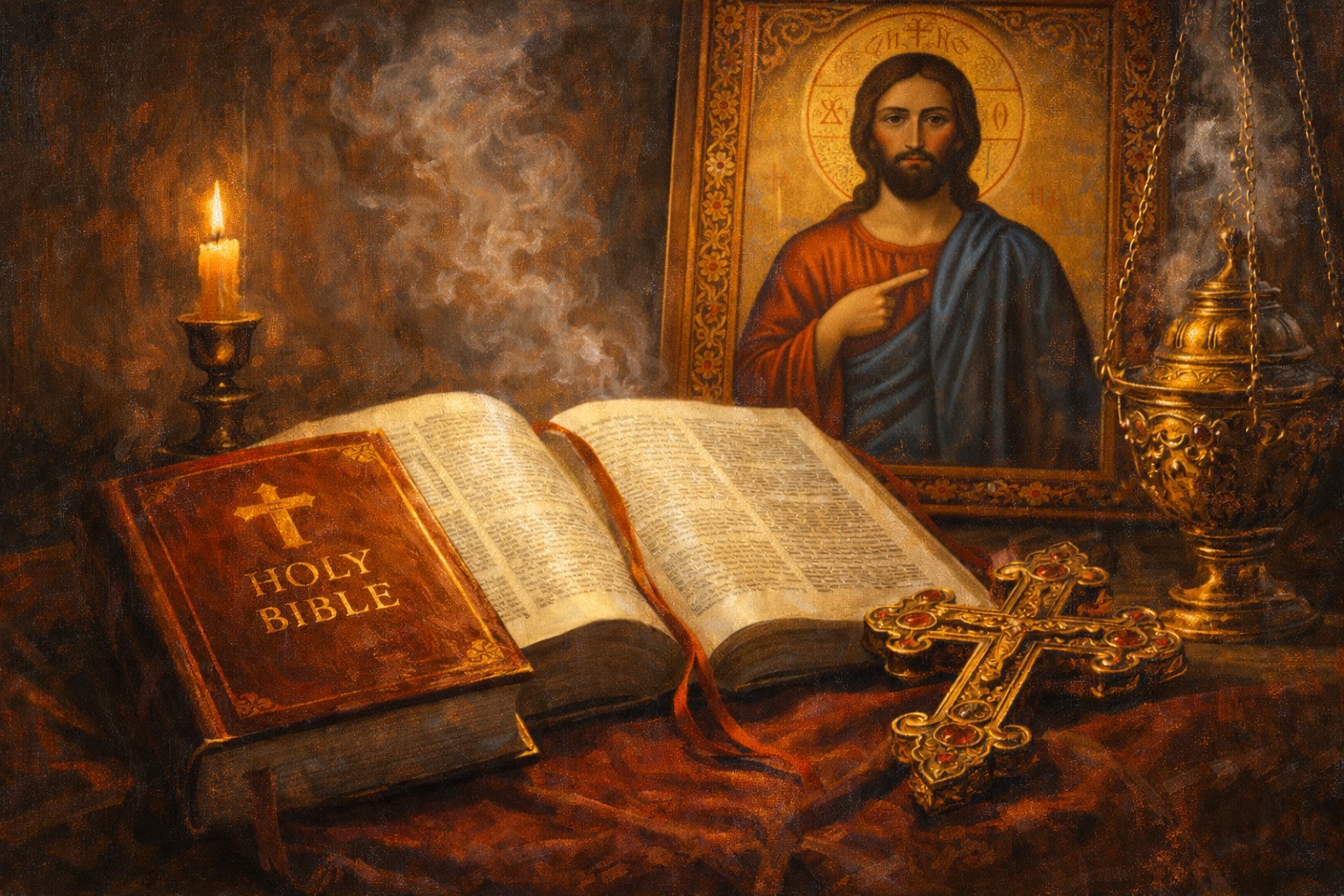
Sources of Christian Doctrine
The Orthodox faith is not built upon a single pillar, but upon many—woven together like the strands of one living body, received from generation to generation as a continuous inheritance.
Revelation
What is revelation, and why do we need it?
To answer this question, we must first recognize that God is, by His very nature, beyond comprehension. He cannot be grasped by the mind nor contained by imagination. The One who brought all things into being is Himself not enclosed within what He has made. We, who belong to the order of creation, are incapable of penetrating what lies beyond the boundaries of the natural world. As Scripture asks:
"Can you find the Lord's footprint, or have you reached the limits that the Almighty made? The sky is high, and what will you do? And there are deeper things than in Hades; what do you know? Or are they not more extensive than the measure of the earth or the breath of the sea?"
(Job 11: 7–9, LXX)
Yet the world is not silent. Creation itself bears witness to its Maker:
"The heavens are telling of divine glory, and the firmament proclaims His handiwork. Day to day spews forth utterance, and night to night proclaims knowledge. There are no conversations, nor are there words, the articulations of which are not heard. Their sound went out to all the earth, and to the ends of the world their utterances."
(Psalm 18: 2–5, LXX)
From the beauty, order, and power of creation, something of the invisible God may indeed be perceived, for "since the creation of the world His invisible attributes are clearly seen, being understood by the things that are made, even His eternal power and Godhead" (Romans 1: 19–20, NKJV).
And yet this knowledge, real though it is, remains distant. It tells us that God is, but not who He is. To know God personally—not merely about Him, but Him—He must make Himself known. Even in ordinary human relationships, no amount of observation or investigation can replace encounter; one may study a person endlessly and still remain a stranger. So it is with God. If He is to be known in truth, He must introduce Himself. And in His compassion and His desire for communion with us, He does precisely this: "The Lord is God and has revealed Himself to us" (Psalm 117: 27, LXX).
The Gradual Unfolding of Revelation
Creation
The Almighty Creator, calling the heavens and earth into existence by His word.
Abraham
The God who speaks, who promises, who binds Himself in relationship.
The Exodus
The God who saves, who forms a people and gives them a way of life shaped by holiness.
The Prophets
The Law alone is not enough; the heart itself must be renewed. A Messiah is promised.
Jesus Christ
The fullness of revelation. God makes Himself known completely.
This progress reaches its fullness in Jesus Christ, God's only-begotten Son. In Him, God makes Himself known completely, not by exhausting the divine mystery, but by making it truly present and knowable. As Christ Himself declares, "He who has seen Me has seen the Father" (John 14: 9). St. Paul bears the same witness: "God, who at various times and in various ways spoke in time past to the fathers by the prophets, has in these last days spoken to us by His Son, whom He has appointed heir of all things" (Hebrews 1: 1–2). And the Gospel affirms: "No one has seen God at any time. The only begotten Son, who is in the bosom of the Father, He has declared Him" (John 1: 18).
Jesus Christ stands at the heart of revelation. He is "The Way, the Truth, and the Life" (John 14: 6). He is "the image of the invisible God, the firstborn over all creation" (Colossians 1: 15). "In Him dwells all the fullness of the Godhead bodily" (Colossians 2: 9), and within Him lie hidden "all the treasures of wisdom and knowledge" (Colossians 2: 3). He comes as a Rabbi, a teacher among teachers, yet unlike all others, He alone possesses "the words of eternal life" (John 6: 68). He teaches "as one having authority" (Matthew 7: 29), fulfilling the ancient promise that in the days of the Messiah, humanity would be "taught by God" (Isaiah 54: 13; John 6: 45).
Christ speaks not on His own behalf alone, for His words flow from the very heart of God: "I have not spoken on My own authority; but the Father who sent Me gave Me a command, what I should say and what I should speak. And I know that His command is everlasting life. Therefore, whatever I speak, just as the Father has told Me, so I speak" (John 12: 49–50). Yet even more profoundly, Christ teaches not only by what He says, but by what He is. He is the living Word—the Logos—through whom "all things were made," and apart from whom "nothing was made that was made" (John 1: 3). He was "in the beginning" (John 1: 1), He "gives light to every man coming into the world" (John 1: 9), and He stands beyond time as "the Alpha and the Omega, the Beginning and the End, [...] who is and who was and who is to come, the Almighty" (Revelation 1: 8). All that exists finds its origin and its purpose in Him, for "all things were created through Him and for Him" (Colossians 1: 16).
What, then, is divine revelation?
It is God's gracious self-giving, His decision not to remain distant but to make Himself known—brought to its fullest expression in the person of Jesus Christ. And why do we need it? Because without it we remain strangers, and with it we are invited into relationship and communion—with the God who has drawn near, who has taken flesh, and who is now truly "with us" (Matthew 1: 23).
Tradition
"The word 'tradition' does not mean 'imitation of the past,' but it means biblically 'delivering a deposit and receiving it.' A generation delivers the faith and another receives it."
— Fr. Tadros Y. Malaty, Tradition and Orthodoxy, Chapter 1
Before ascending into heaven—where He "sat down at the right hand of the throne of God" (Hebrews 12: 2)—Christ sent out His apostles—literally, "those who are sent"—to proclaim Him and His Gospel, the glad tidings of salvation. They were ordered to "make disciples of all the nations," teaching them to observe everything He had commanded them (Matthew 28: 19–20). And they were not left to rely on their own strength. He promised them the abiding guidance of the Holy Spirit: "when He, the Spirit of truth, has come, He will guide you into all truth" (John 16: 13). Thus the Church would endure, unbroken by death or time, for "the gates of Hades shall not prevail" (Matthew 16: 18) against "the house of God, which is the church of the living God, the pillar and ground of the truth" (1 Timothy 3: 15). This living truth—"the apostles' doctrine" (Acts 2: 42)—has been handed down through the ages so that all may have access to it.
Within the life of the Orthodox Church, "Holy Tradition" unfolds in more than one form. There is the written tradition and the oral, the recorded word and the living voice, bound together in a single inheritance. This is already witnessed by the Apostle Paul, who exhorts the faithful:
"Therefore, brethren, stand fast and hold the traditions which you were taught, whether by word or our epistle."
(2 Thessalonians 2: 15)
Long before most Christians possessed a Bible containing the full New Testament canon, it was the liturgical life of the Church—the celebration of the entire Christian Mystery—that formed them in faith. Through worship they were not merely instructed but drawn into communion with the living God, who seeks fellowship with His beloved children within His Church. The liturgy did not function as a supplement to revelation, but as its living space, where doctrine was sung, enacted, and embodied in prayer.
In the same way, the great Councils of the Church, gathered by bishops and teachers, served as guardians of the apostolic faith. They discerned truth from distortion, separating sound doctrine from heresy, and together with the writings of the holy Fathers preserved the integrity and clarity of Christian belief. Through them, the Church did not invent new truths, but protected what had already been received.
Nor is tradition confined to texts and councils alone. It breathes also in the lives of the saints, whose holiness becomes a visible interpretation of the Gospel; in the canon laws, which give concrete form to spiritual order; and in the artistic expressions of faith—icons, hymnography, architecture—through which doctrine is not only explained but contemplated, seen, and experienced.
All these elements, however, cannot be understood in isolation. They form a single organic whole, woven together like the strands of one living body. None exists independently, and none can be removed without impoverishing the others. Together they are preserved in the Church as a continuous inheritance, received from generation to generation, handed down not as a relic of the past, but as a living reality.
"Thus, tradition is the living stream of the one life of the Church, which brings up the past with all its aspects as a living present, and extends the present towards the morrow without deformation."
— Fr. Tadros Y. Malaty, Tradition and Orthodoxy, Chapter 1
This living stream flows through history without interruption, carrying the faith of the apostles into every age, until the return of our Lord Jesus Christ—to whom belongs all glory, together with His Good Father and His All-holy and life-giving Spirit. Amen.
Scripture
The Bible—derived from the Greek "βιβλία," meaning "books," and also called "Holy Scripture", from the Latin "scriptura," meaning "writings"—is not a single book, but a library. It is a collection of texts composed by many different authors, across more than a thousand years, in diverse lands and continents. And yet, in spite of this diversity, it unfolds as one unified narrative: the story of how God has acted within history and revealed Himself to humanity, from the dawn of creation until the first century A.D. Within its pages are found many voices and many forms—history and prophecy, poetry and wisdom, letters and prayers, visions and apocalyptic mysteries.
The Bible is traditionally divided into two great parts: the Old Testament and the New Testament. They are called Testaments, or Covenants, because each bears witness to a distinct stage in the history of salvation—a stage marked by a living relationship, a binding commitment, between God and humankind.
The Old Testament
The Old Testament opens with the five books of Moses the prophet. In them we encounter the foundational drama of human existence: how God created the world and mankind out of sheer love; how mankind, deceived by the devil, rebelled against God and turned away from the source of life; how through sin humanity became subject to death; and how, even then, God did not abandon His beloved creation. Instead, He reached out—first to individuals, and later to an entire people, Israel, with whom He entered into a covenant, setting them apart as a holy nation, called to be a light to the world as His chosen people.
After the books of Moses, the Scriptures recount the long and turbulent history of Israel: her repeated unfaithfulness, her struggles and wars, her exile and eventual return. Within this story, certain figures shine as embodiments of righteousness and faith. Esther, queen of Persia, risks her life to save her people. David, king of Israel, receives a promise from God that a descendant of his shall reign forever. Others, however, stand as warnings—like King Saul, who loses his throne through disobedience to God's commandments.
Alongside these narratives, the Old Testament also contains books of wisdom and instruction. They teach the "fear of the Lord," (Proverbs 1: 7) offering guidance on how to live in a way that honors God, and proclaiming that true blessedness is found not in power or wealth, but in faithfulness and obedience to the one true God.
Finally, and with particular gravity, the Old Testament gives us the voices of the prophets. These men speak by divine inspiration, calling an unfaithful Israel to repentance, urging her to return to the covenant she has broken. Yet their message reaches far beyond moral correction. They also announce hope: the coming of a Messiah—literally, an "Anointed One"—who will defeat the devil, redeem humanity through His suffering and death, and whom God will not abandon in Hades, but will raise to life on the third day.
The New Testament
The New Testament begins with the four Gospels—"εὐαγγέλιον," in Greek, meaning "good news." These writings proclaim the life of Jesus of Nazareth, the Son of God, foretold by the prophets, who establishes a new covenant in His Blood. Through Him, the inheritance once entrusted to unfaithful Israel is opened to all nations. He is the heart of Scripture, the axis around which all history turns. In Him every promise finds its fulfillment; through Him humanity is restored, the gates of heaven are opened, and we are made children of God and heirs of His everlasting kingdom.
Before ascending into heaven and taking His seat at the right hand of God the Father, our Lord Christ commands His disciples to carry this good news to the ends of the earth. The book of Acts, written by the evangelist Luke, records their mission: their sufferings and victories, their preaching and miracles, and the life of the early Church as it spreads and takes root in the world.
Together with the Acts of the Apostles, the New Testament also contains a collection of letters written by them—addressed to particular churches, individual believers, and to the Church as a whole. In these epistles, theology becomes instruction, and doctrine becomes guidance for daily life. They offer exhortation, correction, encouragement, and spiritual wisdom, teaching Christians how to live out the Gospel in concrete reality.
At the very end of the biblical canon stands the book of Revelation—"ἀποκάλυψις," meaning "unveiling." Written in symbolic and mystical language, it reveals the events leading up to the end of the world, yet does not seek to satisfy curiosity about the future, but to strengthen faith in the present, calling believers to remain steadfast, faithful, and unshaken, no matter what trials they may face.
Liturgy
"For where two or three are gathered together in My name, I am there in the midst of them."
(Matthew 18: 19-20)
When the Church—"ἐκκλησία," in Greek, meaning "a called-out assembly"—gathers together, she enters into the mystery of the Liturgy, "λειτουργία," the "work of the people." Yet this work is not merely human: it is a sacred synergy between God and His people, a divine-human cooperation ordered toward the salvation of all. As the Church offers worship and sacrifice, the Lord Himself acts within her: He sanctifies His people and gives them His Holy Body and His Holy Blood "for the remission of sins" (Matthew 26: 28) and for "eternal life" (John 6: 54).
Transfiguring the worship of the Old Testament Temple, the Church's Liturgy now finds its center in the person of Jesus Christ and in the Sacraments He Himself instituted. At the heart of these stands Holy Communion, together with Holy Baptism, Holy Chrismation, and repentance—also called "Confession." In the course of time, the Church, guided by the Holy Spirit, for the sake of pastoral care, also recognized marriage, ordination to a clerical rank, and healing through anointing with holy oil as sacramental expressions of God's grace within human life.
The rhythm of liturgical life extends beyond individual services into the very structure of time. The Church establishes seasons of fasting and repentance, calling her children to mourn over their sins, and seasons of joy, inviting them to rejoice in the lovingkindness of the Lord. As King Solomon once wrote:
"For everything there is a right time, and a right time for every matter under heaven: [...] a right time to weep, and a right time to laugh; a right time to mourn and a right time to dance;"
(Ecclesiastes 3: 1, 4)
Through this sacred ordering of the year, the Church draws her members into an active participation in the life of Christ Himself, so that they may receive the blessings that flow from living the Gospel in truth. For each season, therefore, she has shaped particular prayers and hymns, practices and blessings, through which time itself becomes a path of sanctification.
And when the Lord commanded, "do this in remembrance of Me" (Luke 22: 19) at the institution of the Eucharist, He did not speak of mere recollection, as though the mystery were only to be remembered in thought. He called His disciples—and all who come after them—to real participation: not simply to remember what He once did, but to enter into it, to stand within it, and to receive it as a living reality.
Councils
From the earliest days of her existence, the Church has stood in the midst of struggle. She has been confronted again and again with heresy, with false teachings, and with practices that wound the soul rather than heal it—already in the time of the apostles themselves. As Scripture bears witness:
"For certain men have crept in unnoticed, who long ago were marked out for this condemnation, ungodly men, who turn the grace of our God into lewdness and deny the only Lord God and our Lord Jesus Christ."
(Jude 1: 4)
The danger was not merely external persecution, but internal distortion: truths reshaped into errors, and the Gospel bent into something other than what had been received from the Lord.
In moments of particular gravity, the Church responded not with private opinions, but with communal discernment. Bishops, priests, and appointed leaders would gather in council, seeking to clarify the authentic doctrine handed down from Christ to His disciples.
In the fifteenth chapter of the book of Acts, we encounter the very first such council, convened in Jerusalem to decide whether converts from the Gentiles must observe the Law of Moses in order to be saved. After hearing the testimony of St. Peter—supported by St. Paul and Barnabas—and after the assembly had reflected on these accounts, St. James, who presided over the council, confirmed the emerging consensus by appeal to Holy Scripture. Thus a decision was reached, not through domination, but through shared listening to the voice of God.
This pattern became the model for the Church in later centuries. When disputes over doctrine arose, they were addressed through synods and councils, in which the faithful sought unity of mind under the guidance of the Holy Spirit. Yet not every council truly expressed the mind of the whole Church. Some decisions had to be examined again, and at times reversed, by later gatherings. In the Orthodox Church, only three councils were ultimately received universally by the entire Church, so that their decrees could be sealed with the words: "it seemed good to the Holy Spirit, and to us" (Acts 15: 28). These came to be known as the "Ecumenical Councils"—from "οἰκουμένη," meaning "the whole inhabited world"—for they were recognized as speaking not for one region or group, but for the Church as a whole.
First Ecumenical Council
Nicaea — 325 A.D.
Against: The teaching of the priest Arius, who claimed that "there was a time when the Son was not," thereby denying the full divinity of Christ and undermining the eternal fatherhood of God the Father.
Result: The Church confessed the truth she had always lived by and formulated the first part of the Nicene-Constantinopolitan Creed, which remains on the lips of the faithful in every Liturgy to this day.
Second Ecumenical Council
Constantinople — 381 A.D.
Against: Sabellius (Father, Son, and Spirit are only one person); Apollinarius (Christ lacked a true human mind); Macedonius (the Holy Spirit is a created being).
Result: These teachings were condemned, and the second part of the Creed was composed, confessing the full divinity and personal reality of the Holy Spirit.
Third Ecumenical Council
Ephesus — 431 A.D.
Against: Nestorius, who taught that in Jesus Christ the divine and the human existed as two separate natures, acting independently within one person.
Result: The Council upheld St. Cyril of Alexandria's teaching: Christ is one single reality, the incarnate Logos. The Church confessed the blessed Virgin is Theotokos—"Mother of God."
Thus, through councils and confession, through struggle and discernment, the Church did not invent new truths, but guarded the mystery entrusted to her from the beginning—so that what was revealed in Christ might remain undistorted, living, and saving for every generation.
Fathers
"For Jews request a sign, and Greeks seek after wisdom; but we preach Christ crucified, to the Jews a stumbling block and to the Greeks foolishness, but to those who are called, both Jews and Greeks, Christ the power of God and the wisdom of God."
(1 Corinthians 1: 22–25)
Throughout her history, the Church has brought forth many luminous teachers—men who stood against dangerous and heretical doctrines, who defended the faith against its critics, and who instructed the faithful in the path of a life pleasing to God. Their sermons, letters, and theological reflections are known collectively as the patristic teachings—from the Greek word for "father"—for they are the spiritual inheritance of those who became fathers of the Church in wisdom and in holiness.
In the earliest centuries, the people of God lived under constant pressure and hostility towards their faith. They were scorned by the Jews, persecuted by the Romans, and mocked by the Greeks, yet they did not abandon their sweetest Lord Jesus Christ. In this hostile world, some learned and educated Christians responded not with silence, but with clarity and courage. They addressed the common objections raised against the faith, exposed the emptiness of pagan belief, and revealed the tragedy of the Jewish rejection of our Lord Christ, to whom belongs all glory. These men became known as the apologists of the Church—defenders of the faith whose writings remain strikingly relevant even in the present age.
Others rose up as tireless opponents of heresy. They opposed false teachings with patient reasoning and deep knowledge of Scripture, participated in synods and Ecumenical Councils, and labored to preserve the purity of the apostolic tradition. These fathers are remembered as the theologians of the Church. Yet their task was not merely negative—to refute error—but also profoundly constructive. Through sermons, commentaries, and theological treatises, they articulated the faith in luminous detail, unfolding the meaning of Holy Scripture and uncovering depths that ordinary readers might never perceive.
Alongside these stood fathers devoted to the ascetical life, who trained believers in discipline and self-mastery, shaping them into "spiritual athletes" according to the words of St. Paul: "Do you not know that those who run in a race all run, but one receives the prize? Run in such a way that you may obtain it." (1 Corinthians 9: 24). Others, still, turned their gaze inward and upward, contemplating the mystery of divine-human communion, the inner experience of God, and the soul's union with the eternal. The former are called ascetics; the latter, mystics.
All these patristic voices speak with a rare authority, for they did not arise from speculation alone. They were men shaped by prayer and struggle, who joined a brilliant mind to a righteous life, a caring heart to a pure soul—and above all, a burning love for God and for neighbor. God opened their eyes to perceive the mysteries of the faith, and granted them insight not given to many. For this reason they are called the holy fathers, and for this reason their teachings remain a priceless treasure within the living tradition of the Church.
Apologists
Theologians
Ascetics
Mystics
Saints
All members of the Church are called to holiness. This calling is not reserved for a spiritual elite, but is addressed to every believer without exception, for it is written: "Be holy, for I am holy." (Leviticus 11: 44) And in the Holy Scriptures even ordinary Christians are frequently called "saints," as when the Apostle writes: "Paul, an apostle of Jesus Christ by the will of God, To the saints who are in Ephesus, and faithful in Christ Jesus" (Ephesians 1: 1). The word saint itself simply means "set apart" or "holy one," pointing not to moral perfection, but to a life consecrated to God.
Yet within this universal calling, there are certain luminous figures who stand as pillars of the Church—men and women whose lives were so deeply conformed to Christ that the Church has recognized them as especially holy and worthy of honor. These are the ones we usually mean when we speak of "the saints of the Church." While patristic teachings instruct us through words, the saints instruct us through their lives. They are the Gospel made visible. Their stories become living icons: we see how they endured suffering, how they responded to injustice, how divine love took flesh in their actions. Their radical faithfulness awakens hope within us, draws us toward deeper repentance, and stirs gratitude for the grace and greatness of God at work in human lives.
Martyrs
Who followed Christ even unto death: "Greater love has no one than this, than to lay down one's life for his friends." (John 15: 13)
Confessors
Who endured torture and persecution for the faith but were preserved alive by God's providence.
Wonderworkers
Through whose hands God healed the sick, delivered the suffering, and revealed His mercy through miracles.
The Hidden Saints
Countless others whose holiness shone not through public deeds, but in hidden faithfulness in prayer, humility, and love.
The saints are not relics of the past. They are alive even now. As the Lord Himself teaches: "God is not the God of the dead, but of the living." (Matthew 22: 32). Together with the heavenly hosts and the angelic powers, they form what may be called the invisible Church—the Church beyond time and space. They love us, they pray for us, and they rejoice exceedingly when we turn away from sin and return to the embrace of our Heavenly Father.
In them we see what Christianity looks like when it is truly lived. They show us not only what is possible, but what is promised. Their lives become a mirror in which we glimpse our own calling—not to admire holiness from a distance, but to pursue it with courage and trust. May God bless us through their intercessions, and guide us along the narrow path that leads to righteousness and life.
Canons
The canons of the Church are the sacred rules and guiding norms by which her life is ordered. Some are flexible, shaped by pastoral wisdom and historical circumstance; others are fixed and unchangeable, belonging to the realm of dogma. Together they give structure to the visible body of the Church and form a framework for Christian conduct, addressing not abstract theory, but the concrete realities of daily life. Like doctrinal definitions, canons are not imposed by individuals, but are received through conciliar agreement, established in synods and councils under the guidance of the Holy Spirit.
In a special way, the canons concerning the Holy Sacraments exist to safeguard reverence toward the grace of God. They protect what is holy from becoming ordinary, and what is divine from being treated lightly. For the clergy, this includes prohibitions against selling the sacraments, against blessing same-sex couples, against revealing what has been confessed, against offering Holy Communion to the unbaptized, and many similar boundaries meant to preserve the sanctity of their ministry. For the faithful, these canons call for fasting before receiving the Eucharist, for regular confession as preparation for Communion, for fidelity to marriage without entering a new union while a previous one remains sacramentally binding, and for other forms of disciplined obedience.
Canons do not exist to burden consciences, but to guide souls. They set a standard not for punishment, but for healing; not for control, but for spiritual direction. In this sense, the canons function as a map for the journey toward holiness, helping believers remain aligned with the will of God and avoid paths that lead to spiritual harm. To study them is therefore not only to learn rules, but to gain practical wisdom—wisdom shaped by centuries of prayer, experience, and love for the salvation of humanity.
Iconography
Man, created in the image of God, was blessed with the gift of creativity—the ability to shape the world around him as a humble reflection of the divine act of creation and of the beauty that flows from it. In the life of the Church, this creative power is transfigured and sanctified. Music, painting, poetry, iconography, and every form of sacred art become vessels through which the soul expresses its love for God as it is personally perceived and inwardly experienced. Such creativity has the power to lift the human heart toward heaven, to awaken praise, to draw the mind into reverent wonder before the Lord. It invites a person to descend into the depths of their own being, to examine both light and shadow, and to seek transformation in the presence of divine beauty.
Among all forms of sacred art, icons hold a unique and profound place. They are not mere images or portraits of those they depict—and indeed, they are not meant to be—for they reveal a transfigured reality. In them, the saints remain truly themselves, and yet they appear glorified, filled with the life of God. They bear the marks of suffering and the sign of the Cross, and yet they already stand in victory, radiating peace, light, and love. The icon does not represent a person as they once were, but as they now exist in the Kingdom of God.
In the same way, church buildings, sculptures, hymns, chants, and countless other artistic expressions arise from human hands and hearts in order to glorify God. They are woven into worship so that heaven may touch the earth and the earth may be lifted toward heaven. They teach the faith without words, awaken holy reverence, and draw believers into deeper love for our most compassionate God, His only-begotten Son Jesus Christ, and His life-giving Spirit, so that the faithful are led to glorify the All-holy Trinity—not only with their lips, but with their whole being, in thought, in word, and in deed.
Summary
Sources of Christian Doctrine: receiving the apostolic faith as one living inheritance.
Previous Topic Next Topic Back to Home