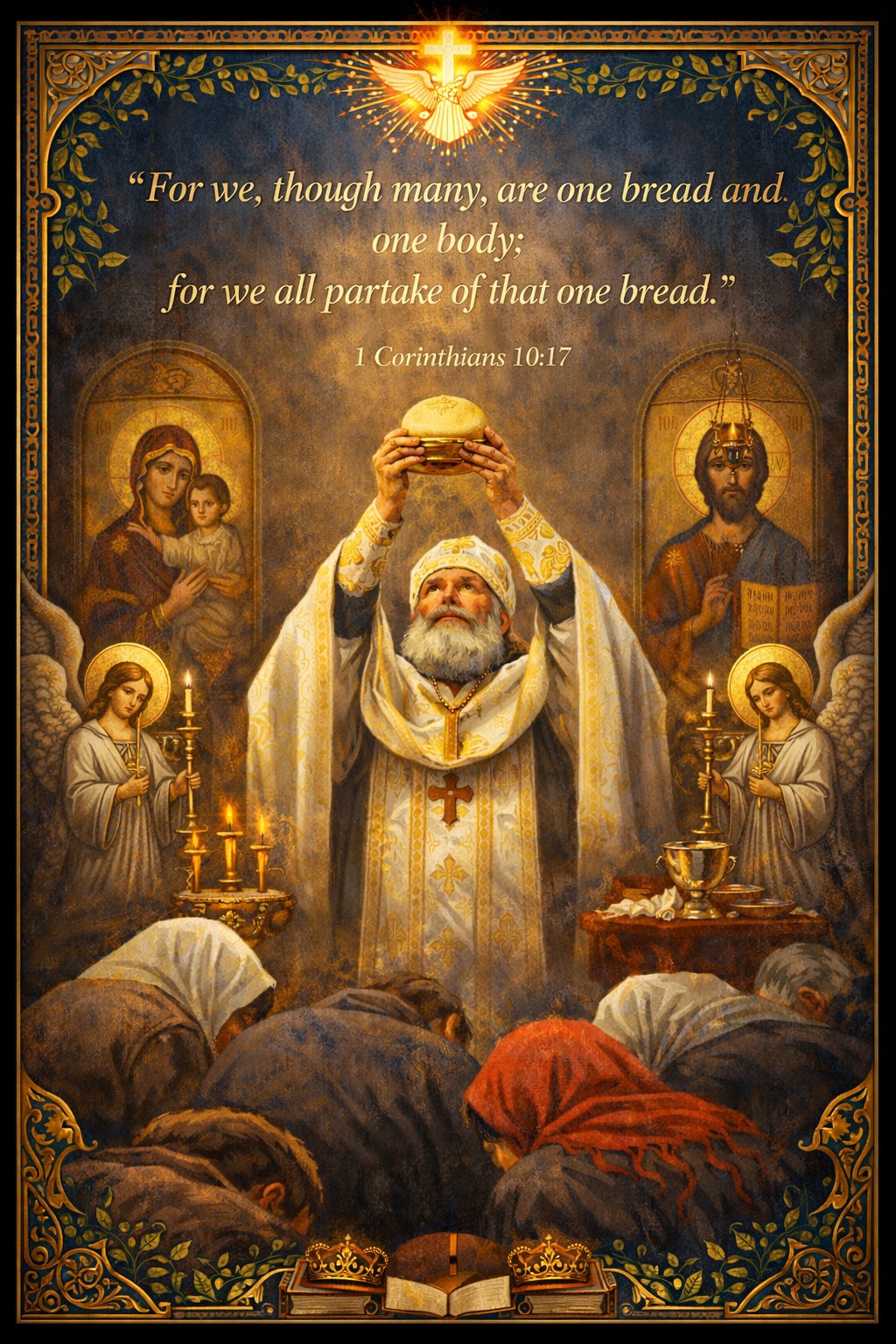
The Bread of Life
Holy Eucharist is the heart of the Church. It is the highest form of worship and the daily meeting with Christ to become one with Him.
It is simply, praying over the bread the wine and asking the Holy Spirit to come down to transform them to the body and the blood of Christ in the prayer that we call the divine liturgy. The term "Eucharist" translates to "thanksgiving." Orthodox believers regard this as a Holy Mystery wherein the participant partakes of the Body and Blood of Christ in the form of bread and wine.
Institution of the Eucharist
This theology draws upon the accounts of Jesus feeding the 5,000, after which He transitioned from discussing physical nourishment to spiritual sustenance.
"I am the bread of life. Your fathers ate the manna in the wilderness and are dead. This is the bread which comes down from heaven that one may eat of it and not die. I am the living bread which came down from heaven. If anyone eats of this bread, he will live forever; and the bread that I shall give is my flesh, which I shall give for the life of the world."
Covenant Thursday
On Covenant Thursday, our Lord Jesus Christ instituted the Holy Eucharist, after he celebrated the Jewish Passover.
"He took bread, blessed it and broke it, and gave it to the disciples and said, 'Take, eat, this is My Body', then He took the cup and gave thanks, and gave it to His disciples saying 'Drink from it, all of you, for this is My Blood of the New Covenant, which is shed for many for the remission of sins'." (Matt. 26:26-28)
This action thus became the center of the Christian life, the experience of the presence of the Risen Christ in the midst of his People (see Mt 26; Mk 14; Lk 22; Jn 6 and 13; Acts 2.41-47; 1 Cor 10-11).
The Divine Liturgy
Etymology
The word "liturgy" in classic Greek means a "public service undertaken on behalf of the people." It comes from "laos" meaning "people" (λαός) and "ergon" meaning "work" (ἔργον). This relates to the "service of the altar or the priestly service." The Church has used this term since the apostolic age to include all the worship that is officially organized by her and which is offered by all her members.
Elements of the Liturgy
In the celebration of this liturgy, the Church uses wheat bread and pure wine?that carry deep theological symbolism regarding Christ's nature and sacrifice.
The use of bread is linked to Jesus' self-description as the "grain of wheat" (John 12:24). Similarly, the use of wine connects to His declaration, "I am the true vine" (John 15:1).
The True Body and Blood
In the Orthodox Church, the eucharist is understood to be the True Body and Blood of Christ, it was never understood as a symbol. St. Cyril of Jerusalem notes: "Through this Divine Mysteries, you become of the same body and blood with Christ."
"Wherefore with full assurance let us partake as of the Body and Blood of Christ... for thus we come to bear Christ in us, because His Body and Blood are distributed through our members; thus it is that, according to the blessed Peter, we become partakers of the divine nature."
Foreshadowing the Holy Eucharist
The Passover Lamb
Just as God visited the faithful in bondage and led them to freedom through the paschal meal, Christ is our new Passover. Through His Body and Blood, we transition from the darkness of sin to the Kingdom of Light, making the Liturgy a journey toward heaven. St. Paul confirms this: "For indeed Christ, our Passover, was sacrificed for us" (1 Cor 5:7).
The Manna
It represents spiritual nourishment. The Exodus models our Christian journey: guided by the Cross (the staff) and the Holy Spirit (the cloud), we pass through Baptism (the Red Sea) to be fed by the Eucharist in the wilderness of life. Unlike the manna that could not prevent physical death, Jesus offers eternal life. (John 6:49, 51)
The Coal of Isaiah
It illustrates purification. St. Ephrem likens the glowing coal that cleansed the prophet to the Body of Christ that sanctifies believers: "Then one of the seraphim flew to me... And he touched my mouth with it, and said: 'Behold, this has touched your lips; Your iniquity is taken away, And your sin purged.'" (Isaiah 6:6-7).
The Bloodless Offering in Malachi
It foretells a universal sacrifice offered by Gentiles, typifying the Eucharist celebrated on altars worldwide: "For from the rising of the sun, even to its going down, My name shall be great among the Gentiles; In every place incense shall be offered to My name, and a pure offering." (Malachi 1:11)
Medicine and Healing
"And may they become for all of us communion, healing, and salvation for our souls, bodies, and spirits." ? Liturgy of St. Basil
This petition echoes the ancient understanding of the Eucharist as a spiritual cure. As written in The Epistle of Ignatius to the Ephesians, we are called to "come with an undivided mind, breaking one and the same bread, which is the medicine of immortality, and the antidote to prevent us from dying."
Through the Eucharist, Christ heals us from the wounds of sin with His divine love. He is the Healer of the brokenhearted, the One who opens the eyes of the blind, and the Liberator of captives; all these great gifts are found in the Holy Eucharist.
"He who eats Me will live because of Me" (John 6:57).
Resurrection and Eternal Life
The core of life
St. Athanasius the Apostolic: "Eternal life is the mystery of the everlasting union between the Father and the Son. Revealed to us in this Holy Mystery, it invites us?when we receive Him?to enter into the very core of the life shared by the Father and the Son."
"The Divine Body and Precious Blood placed on the altar are the Body and Blood of the Risen Christ; therefore, they carry the power of eternal life."
This is why, at the conclusion of the Divine Liturgy of St. Basil, we pray: "Given for us for salvation, remission of sins, and eternal life to those who partake of Him."
"Come, you are discerning, let us delight today in the teaching, the taste whereof is sweeter than honey and the honeycomb. Come and be filled with the table that is full of life." ? St. Jacob of Serugh
"I have no taste for the food that perishes nor for the pleasures of this life. I want the bread of God, which is the flesh of Christ... and for drink I desire His blood which is love that cannot be destroyed." ? St. Ignatius of Antioch
The Mystery of the "Eschatological Banquet"
Abiding in God
"He who eats My flesh and drinks My blood abides in Me, and I in him" (John 6:56).
St. Athanasius the Apostolic: "It is a mutual abiding that secures the union, guarding it against human weakness and the tendency to drift away. We do not abide in Him solely through our own frail capabilities... Therefore, Christ secured this bond Himself, affirming: 'and I in him'."
Communion of Love
The Eucharist is a true union between the Creator and the created. St. Cyril of Jerusalem describes this fusion beautifully:
"Just as by melting two candles together you get one piece of wax, so, I think, one who receives the flesh and blood of Jesus is fused together with Him, and the soul finds that he is in Christ and Christ in him."
Unity with God who is Trinity
"Join us to Yourself through our partaking of Your divine Mysteries, that we may become filled with Your Holy Spirit"