
We Have Found Jesus
An Invitation to Know Each Other
Begin the Journey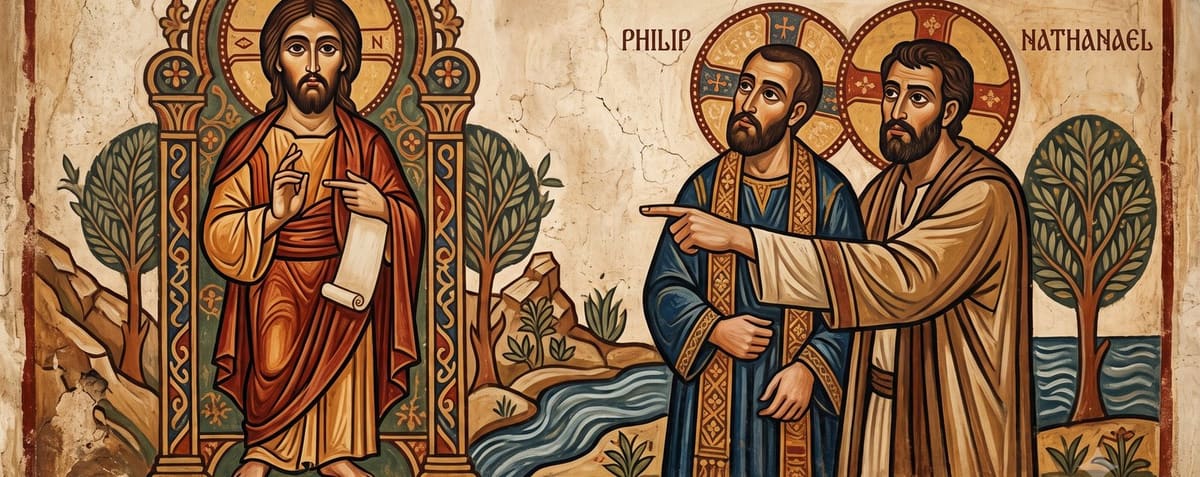
A Personal Acquaintance
It is not enough for us to know who Jesus is. It is absolutely necessary to know Jesus and to encounter Him.
The first chapter of the Gospel of John is a chapter of acquaintance. In it, Saint John the Apostle begins by introducing the people to who the Lord Jesus is. His introduction was clear, and from that time on, humanity has known the Lord as the Son of God, the Incarnate Word. Then, throughout the chapter, the Apostle recounts how people got to know Jesus personally, how they met Him, and how He knew them and met them.
Personal Encounter is Necessary to Know Jesus
It is true that John the Apostle introduced us to who Christ is as he knew Him, but it is not enough for us to know who Jesus is. It is absolutely necessary to know Jesus and to encounter Him.
Jesus is the grain of wheat, so we must take Him. He is the truth, so we must experience Him. He is the life, so we must live Him.
Jesus is the door, so we must enter through Him. He is the way, so we must walk on it. He is the Word, and we must comprehend Him.
Therefore, brothers, it is not enough for us to know who the Lord is through abundant knowledge in books, but rather we must know Him personally. And we cannot know Him personally except by encountering Him; taking Him, experiencing Him, living Him, entering through Him, walking on His path, and comprehending Him. The Lord is humble; He precedes you to the encounter and precedes you to acquaintance. He wants you before you want Him, and He longs for you to love Him as He loves you.
Many met Jesus and, due to his great humility, did not recognize him; some stumbled over him. Jesus, humble and condescending, did not rebuke them, but rather, from his humility, he taught them:
Encounters with Jesus
1 John the Apostle narrates the story of the Baptist's encounter with Jesus like this:
"The next day John saw Jesus coming toward him, and said, 'Behold, the Lamb of God, who takes away the sin of the world! This is he of whom I said, "After me comes a man who ranks before me, because he was before me." I did not know him, but that he might be revealed to Israel, therefore I came baptizing with water.'"
It is essential, my brothers, to confess and bear witness in order to have an encounter and a vision.
2 Then the Apostle narrates the story of the encounter of two disciples who were with the Baptist and left him to follow Jesus.
"The next day again John was standing with two of his disciples, and as he looked at Jesus as he walked, he said, 'Behold, the Lamb of God!'"
The two disciples decided to follow Jesus when they heard his words. His words captivate the soul and attract the heart. Whoever hears them wishes to see him and longs never to forget him, wanting to follow him. His words were to the two disciples like a spirit calling them. So they left John and followed him.
It is essential, my brothers, that we hear Jesus' words so that we can leave everything and become his disciples. No one can hear Jesus' words and remain worldly.
"Jesus turned and saw them following, and said to them, 'What are you seeking?'"
Christ always asks those who follow him what they seek in him and their intention in following him. This is because many seek him for a sign, and many follow him for perishing food. He does not wish for anyone to come to him except those who seek him personally. The Spirit guides us to seek the person of Jesus, and all who seek Jesus in the Spirit seek him as Lord.
Jesus asks people to follow him to be with him, and to become like Jesus.
A call to get to know him.
John the Apostle tells another encounter, perhaps it is with you.
The next day, Jesus wanted to go to Galilee, and he found Philip and said to him, "Follow me." (John 1:43)
Was Philip the only one in Galilee?
Many Galileans met Jesus, but he only said to Philip, "Follow me."
Do not ask why, but be careful not to be like Philip, and get busy with many questions and miss the call.
When you read Jesus' words, you find that they point to you, his words are like a watchful eye upon you. Do not look at others, and do not look at the rejected Galilee. You are Philip, do you not want to be?
Jesus' going to Galilee was to meet Philip and call him, and now his voice has gone out to all corners of the earth to call, to call everyone; everyone has become like Philip. The whole world has become like Philip to Christ, because he died for the whole world to call the whole world to him.
Philip will convict the world that has turned away from Christ, because Philip readily accepted the call. Are you willing to be condemned with the world that has turned away from Christ?
4 Then the Apostle John tells a final story about an invitation to meet, perhaps it is our invitation.
Philip found Nathanael and said to him, "We have found Jesus, about whom Moses wrote in the Law and the Prophets."
Philip, before being invited, found Jesus. He said, "We have found Jesus." How wonderful is this discovery and how precious is this presence! When, Lord, will we find you like Philip? Philip found Christ.
He confirmed the existence of Jesus, reviewed His existence according to the Law of Moses and all the Prophets, and found that He is the fulfillment. Oh, the joy of discovery! Oh, the certainty of existence! When will we rejoice in the certainty of Your existence, O Lord? We, like Philip, have found Christ.
Renewal and resurrection with the spirit of resurrection for eternal life.
Philip found Nathanael and said to him, "We have found Jesus. Come and see." Philip became a preacher. He said, "Come and see."
He went with him personally, got to know Him, and became one of His followers.
Whoever finds Christ this way can invite others to Him. Philip preaches what he found; he proclaims what he saw. "Come and see." Jesus said this to His disciples. Philip said to Nathanael, "Come and see." This is the essence of preaching. It is a meeting and a vision; it is the path of preachers.
Guidance, then direction. The Spirit and the Bride say, "Come." And whoever hears, let him say, "Come." Philip is a mediator of acquaintance; he invites others to find what he found and to see what they saw.
This is true preaching; only those who have found it invite others to it.
"Nathaniel, how do you know me?" Jesus replied, "Before Philip called you, when you were under the fig tree, I saw you."
John 1:47-48
Nathaniel came to Jesus and recognized Him. He knew that Jesus had already known him. He had seen him under the fig tree before Philip called him.
Everyone who has not yet met Jesus thinks that they are unknown to Jesus. But when we accept
Him and know Him, we realize that He was with us, He was following us, He was watching our movements, He was
tracking us everywhere.
We Have Found Jesus
An invitation that changes life and transforms the heart.
An Invitation to Know Jesus
My brothers, these words of mine are also a call. And a call to know Jesus is a call to unity, and it is also a call to love. For there is no love without knowledge. If you do not know Him, how can you love someone you do not know? When knowledge ceases, love ceases, and unity necessarily ceases.
If knowledge is divided and sectarian within Christ, then love is divided and unity is broken.
Two quarreling people will not enter the kingdom of God, because there is no kingdom of two kingdoms; its path is reconciliation.
Quarreling is an oversight of the cross, an insult to Christ's effort and preaching, and a contempt for the work of reconciliation that the Lord Jesus is still doing before the Father through intercession. Quarreling in Christianity is not physical combat, nor the exchange of hurtful words, nor breaking off relations with hatred, nor isolation with resentment. For these types are not great in Christianity and have no meaning in Christianity; they are, in short, un-Christian.
But contention in Christianity is intellectual division, it is the exchange of conflicting and incompatible principles that wound not the contenders, but Christ. Contention in Christ is separation and isolation in principles. Contention in Christ is disagreement in knowing Him, it is yes and no in the one Christ.
When two disagree on a matter of Christ, the cross stands between them, interceding for their disagreement. He who prefers the cross to contention prevails. But if the two become preoccupied with contention and neglect the cross, the cross will depart from between them, and they will together face God's wrath.
When two disagree in their knowledge of Christ, they conspire against love. The knowledge of Christ has no disagreement, for love is not corrupted by two. Only those who love know Christ.
If two agree in their knowledge of Christ, they agree in love, and become two in spirit. The knowledge of Christ is clinging to the Lord, of whom Paul spoke to us.
Knowing Jesus, the Foundation of Our Worship
Impersonal Worship
Knowing the Person of Jesus
Jesus is not merely a subject of knowledge, nor merely a subject of faith, nor merely a subject of worship. If we think so, we negate the person of Jesus and cannot love him. We create a deep chasm of intellectual worship between ourselves and him.
God is being, and Jesus is the Son of God, personified, who reveals God to us and reveals Himself to us.
...
No other strange worship can contend with it and expel it if it can seize the thought and its perception.
All objective worship is inherently devoid of love, and all that lacks love is not worship, but inevitably leads to denial and loss.
If our worship is not based on the personal righteousness of Jesus Christ, it turns into false worship and an attempt to establish self-righteousness, like the Jews. I testify to them that...
Love emotions towards him, they are reflected back to the self as a torturous worship where its pleasure
and satisfaction is in the self itself.
If the reading of the word is not out of longing for the knowledge of Jesus and his love, then the Gospel
becomes a source to feed the self with pride instead of comfort, joy, and fullness.
All worship that is not according to the knowledge of Jesus Christ and directed towards his person is vain.
The worship of the Jews was rejected, even though it was zealous, because it was not
Knowing Jesus and the Church
The sole work of the Church is to present to you the person of Jesus the Savior so that you may know Him. She presents Him to you in the Gospel, in the Sacraments and Rites, and in Tradition and Canon Law. The goal of the Church is to introduce you to the person of Jesus, the Love. The message of the Church begins and ends with this. Your work in the Church is to know Jesus personally through all the means of grace. Your worship must spring from love, your love must blossom into faith, and your faith must be in knowing the Person whom you worship. You cannot know Jesus except through the Church, because the Church knows Him; He entrusted Himself to the Church.
The Church presents Jesus to you as the Lamb of God who takes away the sin of the world. She presents Him to you as a sacrificed Lamb, sacrificed out of love, out of love for you, personally, to save you from your sins.
Christ entrusted Himself to the Church, just as He entrusted Himself to John the Baptist to bear witness to Him. John saw the Spirit descending and resting upon Him when He began the prayer of baptism.
The Church knows Christ and bears witness to Him, presenting Him sacramentally in baptism and on the altar, and in prayer. The Spirit accompanies the Sacraments and prayers of the Church secretly, but He does not reveal Himself openly to anyone, so that Christ may be known by faith, not by sight.
Christ is revealed in His humility; be humble, and you will find Him. He is not in the pride of hiding.
We have found Jesus.
The Voice of the Fathers
Come to Him
St. Athanasius the Apostolic
Oh, you who are thirsty, come to the water; and you who have no money, come, buy and eat! Come, buy wine and milk without money and without cost.
Indeed, His divine nature is marvelous, that He makes our thirst and struggles His delight. He Himself is life; what can we not expect from Him?
And though the Word became flesh, He even makes our bodies rational.
The Word.
And though He is the fount of life overflowing, He thirsts as we thirst so that He may urgently call us
to the feast. Let no one who thirsts fail to come to Him.
He does not say, "Go to someone else who is sick." He says, "Come to Me."
You hear from others about Him and His grace, but from now on, you should not drink from others, but from Him.
When you come to the feast, hurry! It is not like human banquets, but it is the Lord. The Lord Himself is the feast. And we do not consider the Lord's feast as indulgence and bodily pleasure, but as a revelation of truth.
The Lord's Supper, the practice of righteousness, the exercise of chastity, the observance of prayer with sobriety and vigilance, the study of Holy Scriptures, distribution to the poor, peace with our enemies, gathering those scattered from us abroad, subjugating the spirit of pride and returning to the humility of thought, peace with all men, exhorting the brethren to love.
Thirst for Him
St. Athanasius the Apostolic
Let us be very eager to gather ourselves together, for we were scattered, oppressed, and dispersed
in former times, and behold, now we have been found; we were far away, and now we have become near, we were strangers, and now we are
If we thirst for Him, He will refresh us; whoever thirsts, let him come to Him and drink.
Thirst is the love with which the saints lived in all times, and they never ceased from it. Their thirst was their constant sacrifice which they offered to the Lord without interruption. They never ceased from their thirst, nor did they find rest from their insistence in seeking to drink.
It is very fitting for us, in these days, to rise with the saints and connect with the Lord with all our being, in purity of body, with confession, with sincere faith, so that when we drink and are filled with the water
ma ywiqi
Unite
Abba Joseph of Scetis
There are many kinds of companionship and fellowship by which people are bound together with a certain kind of affection.
For some, friendship arises after some acquaintance interspersed with praise and commendation.
For others, friendship is based on some sort of negotiation or agreement to exchange benefits, by giving and taking, resulting in some affection.
And for others, friendship arises by virtue of association, or participation in a service, or agreement in science, art, or study.
All these are circumstances that prepare souls for acquaintance, harmony, and kindness, even among the hardened with fierce souls. They gather, and the sons of men gather by agreement, pleasure, and cooperation in robbery, brigandage, and bloodshed, and by association they commit crimes.
There are other reasons for love, where unity and harmony are achieved through natural instincts and the law of blood ties, as is the case in the family between wives and fathers, and among siblings, where the son is preferred over the stranger.
And even this kind of harmony and unity is not found only among human beings, but also among birds and beasts. We see it where, by the spontaneity of natural instinct, the animal defends and protects its young, exposing itself to danger for their sake, without even flinching from death.
And the wonder is that the beasts, snakes, and birds of prey that separated on their own from the rest of the animals due to their ferocity and deadly venom, we find among them peaceful, compassionate, and tender creatures, showing kindness to one another due to the beauty of their shared feelings as the same species. But all these types of bonds are shared by the good and the wicked. They exist in animals and humans alike, and they are all susceptible to corruption. As soon as one separates from another and moves away, unity breaks, affection breaks, and time brings...
The unity of this love is real and indissoluble, growing as much as the lovers grow in perfection and righteousness.
The unity of this love, once established, knows no internal differences or conflicting desires. No matter how intense they become, they cannot break this unity.
However, we know many who, at the beginning, entered into love with such a righteous purpose, and their affection stemmed from their love for Christ. But they did not preserve this affection and love for long; they wounded it.
This may be due to their not maintaining the initial enthusiasm for the purpose with which they entered into the unity of this bond. Thus, the unity of their love lasts only a short while.
The severance of unity between them is merely evidence of not nurturing and strengthening this love with their righteousness, as one would nourish a plant. The flowering of this love is short-lived, perhaps only due to the patience of one party.
But if the unity of love arises from the efforts of one party, no matter how much effort and heroism they exert tirelessly, the outcome of this unity is inevitably collapse due to the triviality and weakness of the other party.
For if an illness afflicts the soul of one striving for perfection, it incapacitates them to the point that they cannot even keep pace with the weak, no matter how much patience the strong exert in tolerating them. Therefore, we say that unity is indissoluble.
And the doctrine endures without wavering or disturbance in those who are united in thought, who seek to desire together and reject together the same things.
We Have Found Jesus
It is not enough, brothers, to know the Lord through extensive knowledge from books, but rather we must know Him personally. And we cannot know Him personally unless we encounter Him, take Him, experience Him, love Him, bring Him in, walk with Him, and comprehend Him.
Whoever has not yet found Jesus thinks that Jesus does not know him, but when we approach Him and get to know Him, then we will know that He was seeing us, He was following us, He was watching our movements, He was pursuing us everywhere.
You cannot know Jesus except through the Church, because the Church knows Him. He entrusted Himself to the Church.
The Spirit accompanies the mysteries of the Church by faith, not by sight.
Christ is revealed in His humility; be humble to find Him, for He is not in the pride of hiding.