
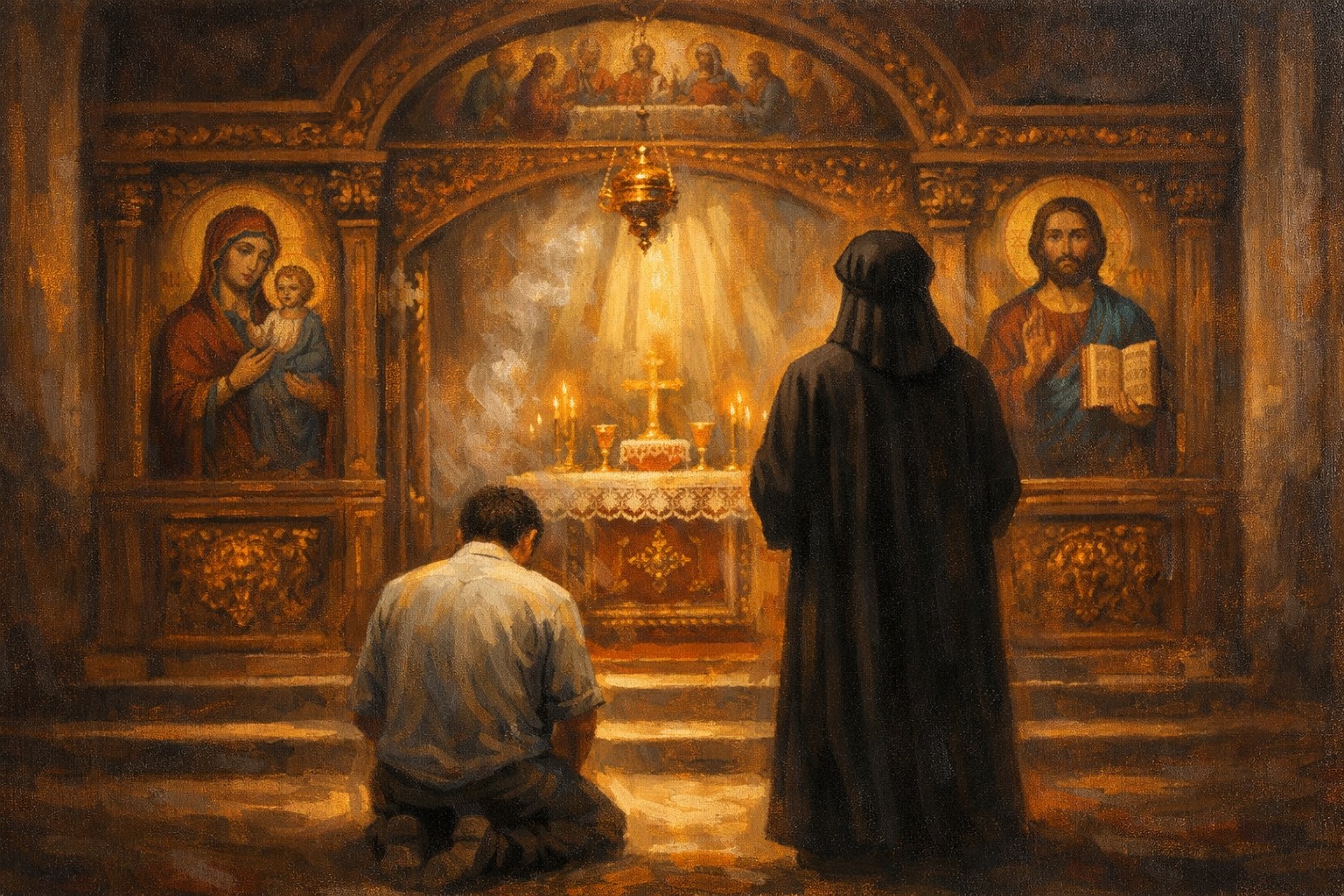
Confession and Spiritual Fatherhood
"Blessed be He Who suffered to heal our pains!"
The sacrament of confession and the role of the spiritual father flow from the Church's conviction that God does not merely forgive from a distance. He draws close to heal, reconcile, and restore the human person.
The healing work of Christ reaches the brokenhearted first.
The Church Fathers describe confession not as a legal interview, but as an encounter with the Physician of souls. Christ does not merely announce forgiveness; He restores what sin has wounded.
"The Spirit of the Lord is upon Me, because He has anointed Me to preach the gospel to the poor. He has sent Me to heal the brokenhearted, to proclaim liberty to the captives and recovery of sight to the blind, to set at liberty those who are oppressed, to proclaim the acceptable year of the Lord."
St. Ephraim the Syrian
"Christ is the Physician Who came to heal our wounds with a medicine that was not harsh. He became the Medicine that showed sinners mercy."
Overcoming the Rift
Dr. Paul Meyendorff writes that the purpose of the Church is to heal us and overcome the rift between God and humanity caused by sin. That healing happens when we are united to one another and to God in the Body of Christ.
Communal Nature of Sin
Based on St. Paul's teaching, we are members of one Body, the Church. Our sins affect the whole body, which is why repentance is always personal and communal at once.
The Ministry of Reconciliation
"Now all things are of God, who has reconciled us to Himself through Jesus Christ, and has given us the ministry of reconciliation... Now then, we are ambassadors for Christ, as though God were pleading through us: we implore you on Christ's behalf, be reconciled to God." (2 Corinthians 5:18-21)
The priest essentially says to the repentant person: "We, the Church, are forgiving you."
Fatherhood in Christ is formed by mercy, not distance.
The apostolic language of fatherhood shows that spiritual guidance is personal, tender, and accountable. A father in Christ does not manage souls from afar; he receives them into a living relationship.
"For though you have countless guides in Christ, you do not have many fathers. For I became your father in Christ Jesus through the gospel."
"To Timothy, my true child in faith..."
"...as a son with a father he has served with me in the gospel."
The Vision of the Spiritual Father
Without a spiritual father, the soul is like a tree without roots, easily uprooted by the winds of temptation. The role of the father is not control, but steady, loving discernment.
"A spiritual father should be in a condition to see the beauty of God's image in a person that cannot be taken away, even if a person is marred by sin... He sees the unshakeable, radiant beauty of His own Image."
The soul is holy ground, and the spiritual father approaches with reverence.
"The spiritual father sees this eternal beauty, treating the person's soul like the Burning Bush. Every human being, potentially or actually, is that very bush. Everything surrounding him is sacred ground upon which the spiritual father may step only after removing his shoes, looking in and knowing that this is the holy place of God."
"One of the tasks of a spiritual father consists in educating a person in spiritual freedom, in the royal freedom of God's children. He must not keep him in an infantile state all his life... but growing into maturity and learning how to hear what the Holy Spirit is wordlessly speaking to him in his heart."
"Then the spiritual father can truly be a travelling companion to his spiritual child, walk with him step by step, protect him, support him, and never intrude upon the realm of the Holy Spirit."
In the Orthodox tradition, the bond between the person confessing and the priest is a deep, living relationship of spiritual father and child. The priest does not sit like a judge in a courtroom, handing out sentences for broken rules. Instead, he acts as a loving father whose only goal is to heal the wounds of his child.
"Confession is a hospital. You go there to heal your soul, not to be judged." - St. John Chrysostom
The fathers consistently describe spiritual care as medicine.
St. Basil the Great
"The spiritual father is like a physician who heals the wounds of the soul with the medicine of repentance and the bandages of prayers."
Sts. Barsanuphius and John
"The spiritual father is a vessel of God's mercy, pouring out compassion and wisdom upon his spiritual children."
A Guiding Light
St. John Chrysostom: "The spiritual father is like a lighthouse, guiding the ship of the soul through the stormy seas of life to the safe harbor of God's kingdom."
Humility in Ministry
St. Athanasius the Apostolic: "The priest is himself a sinner who needs healing. Therefore, he receives forgiveness and healing from Christ alongside the repentant person."
St. Augustine: "I am a pastor for you, under the Pastor. From that position I address you as one who teaches, but with you I am a disciple in the school of the one Master."
Trust in Christ's Healing Power
"Show your wounds to the Lord, the most excellent physician, and seek healing from Him. He does not judge or reproach; He most gently heals."